
Modifications - Exhaust


Like the intake, the stock exhaust is very restrictive. The size of the pipe is adequate, at 2.75 inches, but the muffler is not free flow at all. Modified exhaust, by itself does not usually net any significant horsepower gain, unless in freeing up the flow, boost pressure rises. Most people notice that although there is no peak horsepower gain, the powerband of the car is more flat and the car does not "run out of breath" in the high RPM range quite as quickly. Expected gains can be from five (5) to fifteen (15) horsepower.
Borla
This is the other of the two most popular aftermarket exhaust systems. From a performance standpoint, it is very comparable to the Greddy, however is very different in design. In order to maintain a perfect bolt-up fit to the stock catalytic converter, this system starts at 2.75 inches like the stock system, but immediately expands to full 3 inch pipe which proceeds to just past the rear differential and then splits off into two pipes via a "Y" in the system. The two ends of the "Y" then proceed through Borla XR-1 racing mufflers and then each exit through a single angle-cut 4 inch tip on each side of the car. The system is significantly louder than stock, both inside and outside the car. It is very throaty and definitely attracts attention. This system is also stainless steel and will not rust.
GReddy
This is one of what seems to be the two most popular aftermarket exhaust systems available. It consists of a single large diameter (3.5 inch) pipe going from the catalytic converter to a single 5 inch tip on the driver's side opening. Along the way, there are two resonators and a single large muffler, resulting in a tone that is very deep, but at idle and low RPM quieter than stock. This system is stainless steel and will not rust.
HKS
This manufacturer actually makes two different catback exhausts. Their regular exhaust is made of stock diameter piping which goes from the cat, straight back to a "T" which splits off into the two sides of the car. This exhaust produces sound only a little bit louder than the stock exhaust and comes with a choice of two exhaust tips. The most popular choice is the dual-tip exhaust, which to the untrained eye, looks like it is stock; the other option is a single round 4 inch tip on each side. As far as flow, the regular HKS lags behind the GReddy, Borla, and most well designed custom exhausts, however is a good solution for a premade stock looking exhaust. It has also been proven to over 500 horsepower. The other exhaust, the Super Drager, strongly resembles the GReddy exhaust. It has large diameter piping going from the cat, back to a single large tip exiting on the driver's side. The volume of this exhaust is also a little bit louder than the stock system. One issue that should be noted about the Super Drager is that they do not fit left-hand-drive models of the 3000GT/Stealth correctly out of the box. The flange that connects the catback to the cat must be cut off, rotated, and rewelded on. Any muffler shop should be able to do this. Both HKS catbacks are made of aluminzed steel, which in certain climates will rust out and will have to be replaced.
ATR
ATR offers a cost effective free flowing exhaust alternative. It can be used with an included test pipe (catalytic converter bypass) or with a catalytic converter. ATR can also supply a high flow catalytic converter for use with their system. When combined with the ATR downpipe it becomes a well matched exhaust alternative. The ATR systen does not make use of flex sections in the system which may cause fasteners to loosen over time.
Custom
Anyone who can weld can make their own catback exhaust system. There are both advantages and disadvantages to this. Some of the advantages are control of sound, no compromise of flow, and price. The disadvantages, however, are to weld stainless steel a TIG welder must be used and most people don't have these, messy welds will result in exhaust leaks, and poor choices in bends and mufflers could hurt more than help. Mandrel bends are preferred. Crush bends will require slightly more diamter to achieve the same flow rate. Stainless steel is a cosmetic choice for those in dry hot climates and really only a practical consideration where corrosives are used on winter roads or humidity is continuously high. A good aluminized exhaust can last a very long time and is much cheaper to repair should a problem arise. Keep bends to a minimum and eliminate if possible any 90 degree bends. Shorter is better.
There is definitely a point of diminishing returns when choosing the diameter for optimal exhaust tubing. You must carefully choose the compromises you are willing to forego. Larger tubing will sacrifice some low end torque in favor of high end flow. This may be important for a street driven car when the engine is off boost more than it is on. Turbo spool-up suffers due to the increased volume of the exhaust system while offering better on-boost and high RPM flow.
At some point the rate of flow can actually decrease when the diameter is too large. Remember that usually the exhaust length is not changing. Exhaust gases need to remain hot enough to stay relatively light for the duration of their travel through the exhaust system. The engine is pushing that air out of the tailpipe. Temperatures of the exhaust gases also vary with engine load. In addition, the friction of the surface area of the tubing and the gases causes more drag on the flow on the "boundary layer" of the flowing gases. The "bigger is better" concept oversimplifies the problem of exhaust and cannot be applied without considering total exhaust length. If you plan to dump the exhaust behind the front wheel wells then by all means, bigger tubes will be beneficial. Dumping exhaust at the rear of the car will dictate smaller tubes so that exhaust temperature can be maintained. Cool gases are heavier gases which require higher pressure and more work from the engine (therefore less HP delivered to the wheels) to force the spent gases out of the system.
When choosing mufflers, for optimal performance, consider a straight through muffler such as a Borla XR-1 Racing Muffler or a Dynomax Bullet or possibly no mufflers at all. Turbocharged cars are often inherently quiter since the turbo itself muffles a fair amount of the combustion sound. For a quieter sound, but still freeflow, use multiple free flow mufflers, although this does raise the price considerably. Finish off the exhaust with your choice of exhaust tip(s).
Downpipe
The final restriction in an emissions-legal exhaust setup is the downpipe which connects the piping after the turbochargers to the catalytic converter. The stock downpipe looks like an "F" and is only somewhat efficient for flow. For cars with stock turbos, this upgrade is, unfortunately, very minor. Expected gains can be zero (0) to ten (10) horsepower. Larger turbochargers will benefit greatly from the improved flow, however. The picture below compares the stock downpipe (top) with the offering from Alamo Autosports.
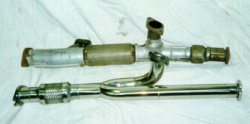 Stock versus Alamo
Downpipes
Stock versus Alamo
Downpipes
Alamo Autosports
This downpipe is of very efficient design. It has slightly larger piping than stock and each pipe that comes from the turbochargers merges into a "Y" that goes into a 3 inch pipe that has a flex section. The flexible section of pipe allows the front of the downpipe to move a little bit to relieve strain on the exhaust system during normal engine movement which occurs under acceleration and when starting.
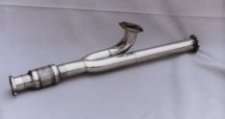 Alamo Downpipe
ATR
The ATR downpipe uses larger diameter piping than the Alamo Autosports model. The merged section has no flex section and all of the flanges are "loose". They are not welded on and can be rotated to accomodate fitment as required. This downpipe comes with two possible connections to the rest of the exhaust. It has a short section with a flange used to connect to the stock catalytic converter and it has an optional longer section that can be used instead to connect directly to the catback portion of the exhaust, bypassing the catalytic converter. This is illegal for use on public roads and is only for race situations. This downpipe is stainless steel and will not rust.
Custom
Downpipes are a little bit harder to manufacture than catback exhausts because of the more precise bends, but the concept is the same. Larger diameter piping is always better. Use at least stock diameter piping, which for stock turbo cars is large enough. The only real option on a downpipe is whether or not a flex section is used. When looking for flex sections make sure the inner diameter is the same as the pipe. Any material may be used as long as it can withstand 1500 degree F exhaust gases.
Turbo Back
Bozz Speed has a dual exhaust solution which reportedly is from the trubo back. More investigation is required.
Turbo Manifolds (headers)
Greddy may offer turbo manifold alternatives for those wishing to fit different trubochargers. IMP also supplies US made turbo headers which accomodate the TD04L turbo.